A day out in Goma...

A day out in Goma...

dsc6877.jpg

Excited specators wait for the show to begin at the Institut de Goma on the 25th of May A couple of months ago, I was invited to a day of performances at the Insitut de Goma. Here are a couple of photos. They are straight off the camera and I might replace them with edited versions if I sort out Photoshop...

The day was organised by a Congolese association of disabled youth: ACDF. The acronym stands for Association Congolais "Debut et Fier" and the organisation runs 6 residential rehabilitation centres across the Congo. The centres provide free orthopaedic services to disabled children and youth. There is one in Goma.

ACDF is mostly funded by StandProud (www.standproud.org) which features in this Pulitzer centre I-book: http://pulitzercenter.org/blog/africa-DRC-congo-children-ebook written by Kem and John Sawyer who visited the ACDF centres in Goma and Kinshasa earlier this year.

So here are some photos from the day...

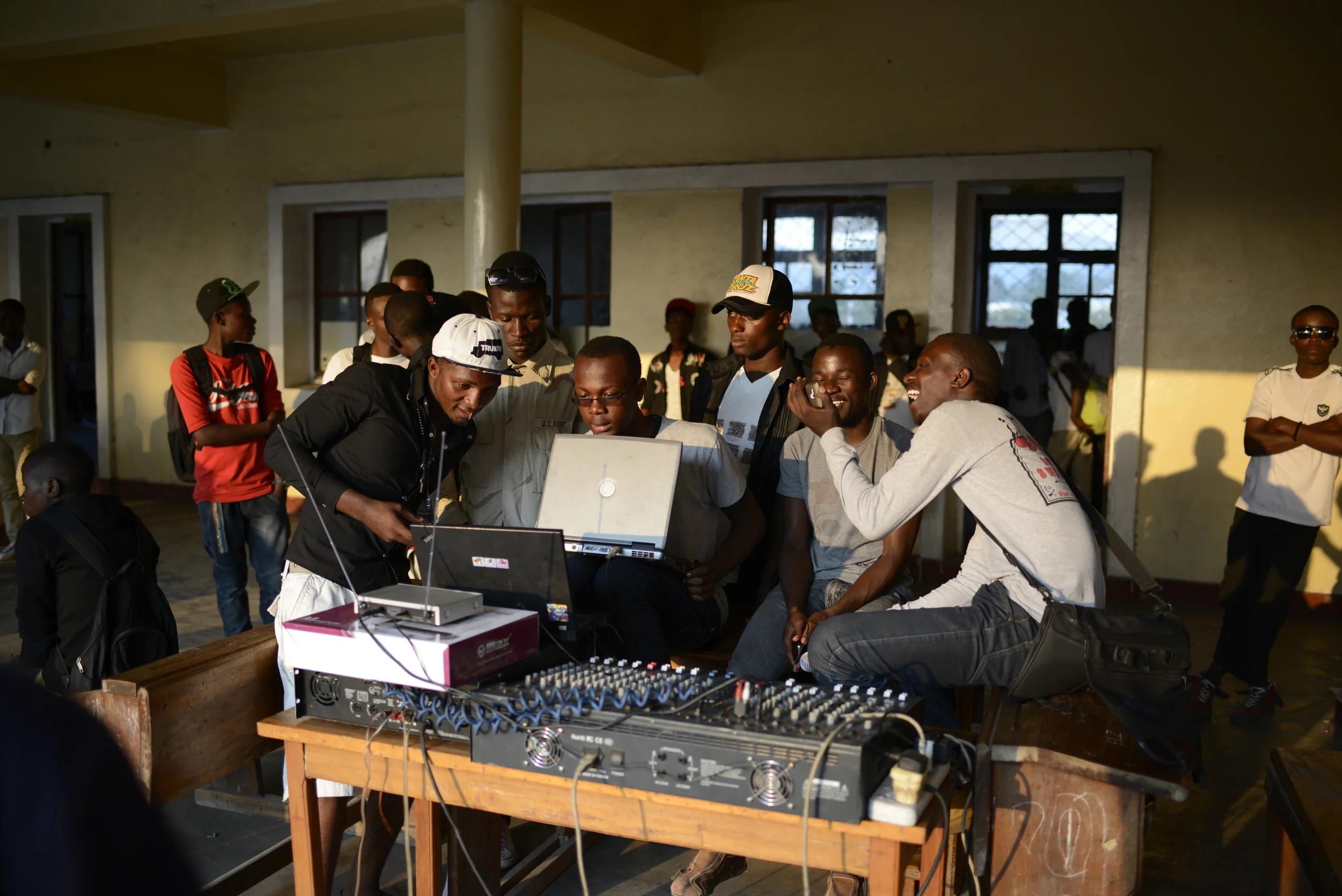
And I always thought DJ-ing could be lonely...


ACDF members performed as well as organising the event...


Paul spoke to the audience and the performers about his life with the effects of polio. He said he was happy that the event highlighted the strengths of disabled people and holding the event in an academic setting also gave a strong message, he said.


Spectators...


What would a show be without theatre and painted faces. Three actors put on skits about life in and around Goma. Through dance, the three portrayed the violence present in everyday life. One student, acting as an armed rebel, is shot by another with a broom in an argument about nothing in particular...


Being shot...


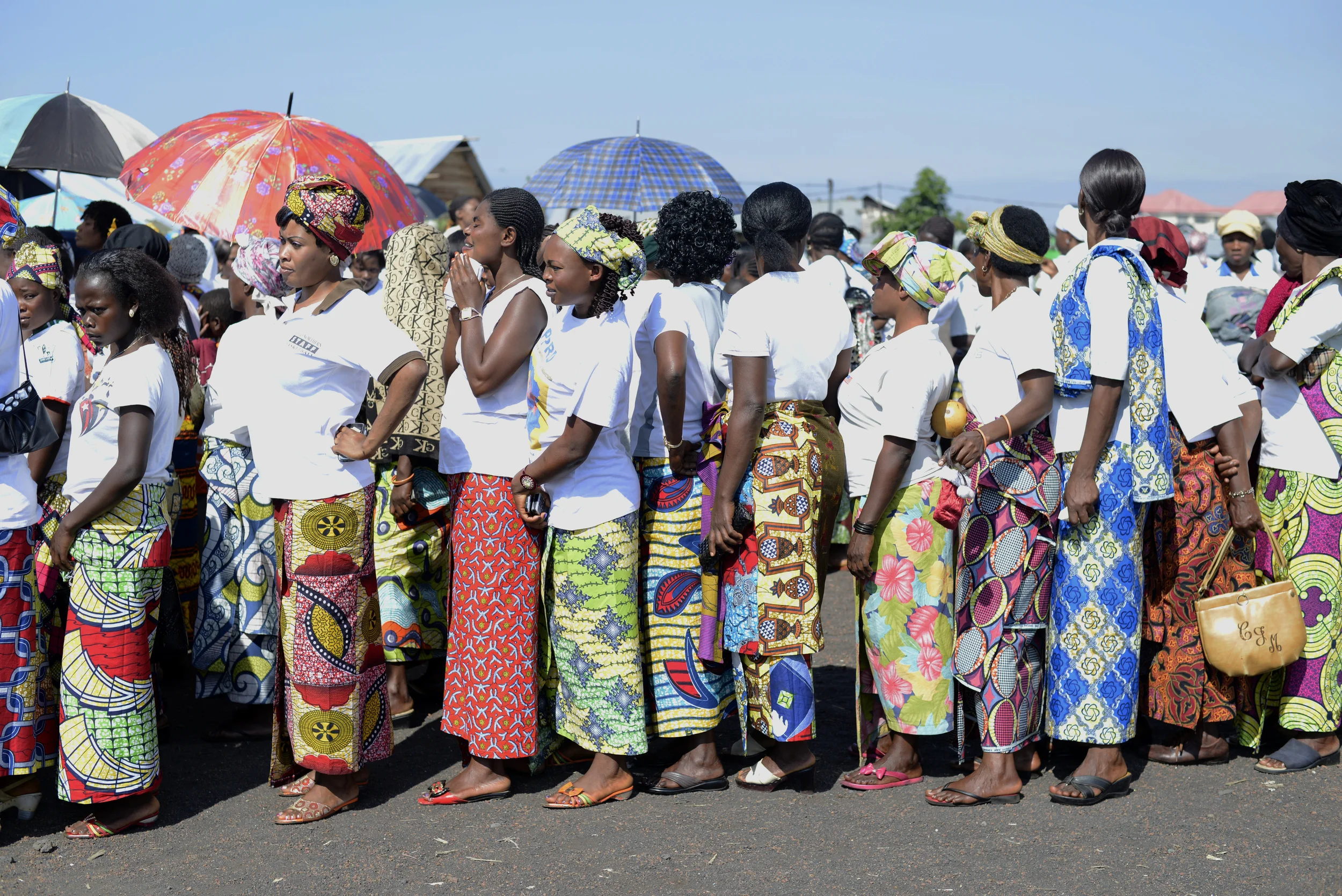
The fashion parades were colourful affairs....


The colours in the wax 'pagnes' are beautiful...


Shady customers?

_DSC6954

One of the loudest changes of clothes in the various parades...

It takes two...

So, that's the day that was.... a couple of months ago.


Some more life in Goma...

As the MONUSCO announces a Security Zone around Goma (but not as far as the FARDC/M23 front lines) to be enforced after 16h tomorrow evening (by force if necessary), life still continues in Goma against the constant backdrop of war and violence... Having fried potatoes, a lady prepares a feast of goat on Sunday...

 DSC_0604

Prices in Virunga Market in Goma have increased slightly due to the recent clashes on the main road between Goma and Rutshuru where many agricultural products are grown to be sold in the Provincial Capital. Although traffic has been passing along the road through no-man's land and across both FARDC and M23 borders for the last four or five days, the week while the road was impassable drove prices up a little.

A group of residents of Kanyarucina took advantage of a lull in fighting last  Tuesday to harvest crops from their fields. They told me they had not had access while the M23 held the town. The crops were not ripe but because they weren't sure when they might get another chance, they picked what they could to sell or eat...

DSC_0445

Cooking on a Sunday is a family activity. To season the goat, one of the lady's sisters crushes garlic...

DSC_0587

And her daughter revises last year's lessons while humming the school "recruitment" ditty  in excitement at the prospect of a new school year in September...

DSC_0622

This studious little girl goes to a private school in Goma that charges tuition fees. The school song is intended to attract new pupils (and their parents) and boasts of the achievements and happiness of the children studying there. The quality of the education received at her school is good - in the two years that she has been studying there, she has learned her times-tables, picked up the basics of French and been introduced to Congolese geography and history. Not all children in DRC have the means to access private education.

However, nearly all children's families pay for education in some form or another.

The DRC is signatory to the International Convention on the Rights of the Child and article 28 of the convention guarantees the right to universal, free primary education. Further, primary education is compulsory and free in public schools according to article 43 of the May 2005 DRC constitution. In 2010 the government launched an initiative to phase in free primary schooling. Starting with the first three years of primary school and intended to increase a year later to cover the final three years - to age 12 -, the initiative gained international support.

Despite the budget for education doubling over the last two years - 13.8% of the total national budget is allocated to education in 2013 - the general government funding gap for the sector is still enormous. As a result, teachers' salaries are commonly "topped up" by parents. This occurs frequently through charges levied on releasing school reports or exam marks, or through teachers maintaining a monopoly on selling school syllabuses that each child needs to follow the course. Sometimes, a parents' committee fund is levied to cover teachers' salaries. So also in public schools families must pay for their kids' primary education.

Of course, this is only one side of the picture. Talking to families, teachers can often be painted as the villains - extorting fees, singling out and suspending children whose families have not paid. There are obviously more sensitive ways to go about raising fees from parents than pulling their primary-school-aged kids up in front of the class for public humiliation and banishment from the classroom until the debts are paid, however,  teachers too must live.

The World Bank donated $20m in March 2011 to support teachers' salaries. Unfortunately, the project information on the World Bank website is incomplete - "A Results Framework for this project is currently not available" - and so it is not possible to calculate from these data the total annual dollar amount necessary to pay public school teachers across DRC.

According to the Brookings Institution (here), based on a 2012 paper "there are between 350,000 and 450,000 teachers, with just over half of these teaching at primary level". The World Bank puts the figure at a worryingly precise 296,544 primary school teachers across DRC. Given that the average salary for a primary school teacher is between $35 - $40 a month, the World Bank support should have covered two years' salary as the total dollar amount needed annually (based on WB estimates) is somewhere between $10,379,390 -  $11,862,160. That didn't happen - some teachers went unpaid for long periods in 2011 and 2012 which led to teachers' strikes. Maybe the money was intended for other things as well- no report on the WB website, so I can't tell...

Anyway, there's a little rant about education in the DRC... got a bit carried away.

Some 10 km away from the studious girl and her family feast, yesterday, an FARDC commando stands ready having cleaned his rifle...

DSC_0691

While his colleague loads his ammunition belt...

DSC_0683

And near to the UN base in Munigi, a third FARDC soldier leans on his tank...

DSC_0783

Life continues near the front in Goma

With violence and war a constant backdrop in the region since 1994, life continues for Congolese people around Goma. Taken this morning: workers start their day at the quarry by the UN base in Munigi while the tanks stand by.

Image

Traffic has been able to travel through the M23 controlled area to arrive in Goma today. The road has been closed to outgoing traffic...

This morning, a heavily laden truck passes one of the last military barriers before Goma.

Image

Residents of Kanyarucina took advantage of the pause in fighting this morning after yesterday's heavy clashes and bombardment to collect all manner of belongings from their abandoned houses.

Image

While soldiers stood around awaiting orders...

Image

Towards the end of the morning, an FARDC helicopter bombed an M23 position to the north of Kanyarucina but otherwise things were quiet near the front and FARDC mortars were silent.

Image

The weekend in Goma: The calm after the storm? Or, is there more to come...?

Goma and its surroundings calmed down for the weekend. There were reports of some light gunfire on Saturday north west of Goma- the front is still between Kanyaruchina and the centre of Kibati- but Wednesday remains the day that has seen the heaviest fighting in the new clashes between the FARDC and the M23 so far. Flash-mobbing in the Kivus

Nonetheless, the city of Goma was hot on Thursday. With rumours flying around about Col. Mamadou being recalled to Kinshasa to be sent to Kisangani, the population of Goma went wild. There was a report from Thursday aired today on a local TV channel with an army wife screaming at the camera. It's a real pity there seems to be no link online- the footage gave a clear example of how angry people were. Mobs in Goma seem to form in a flash. This photo doesn't do it justice, but it's the crowd advancing on me before my driver explained (saving me from harm for the third time that day) that I do not in fact work for the UN:

Image

I was particularly worried by the stone the guy in the middle is brandishing.

A few people I spoke to on Friday night expected fighting on Saturday but this too turned out to be a rumour (I sense a theme...) and there has been no fighting on Sunday. Goma too has calmed down. The government's declarations on radio seem to have done the trick and prevented further protests against the UN in Goma. A motard today said it was because "we don't work on Sundays". With breath stinking of whiskey, it wasn't clear he'd actually understood the question. This coming week will tell but through fairly prompt appearances in the media, the central government and the FARDC seem to be taking the (mis)information war in Goma seriously. Meanwhile, twitter is as busy as ever peddling (mis)information and websites continue to spread rumours- watch this space. Events on Thursday show that, in Goma, even imagined smoke, bouncing off enough motorbike mirrors can cause real fire.

What might we expect this coming week? Well, the troops seem to be at a standstill. Sources in the army say that they are waiting for orders from Kinshasa to attack. Of course, these could come at any moment, but Kinshasa might be waiting for the full deployment of the UN Intervention Brigade which should be complete in the coming 4-6 weeks. Or there might be a bit more to it...

"On est ensemble!"

President Kabila was in Brazzaville across the river from Kinshasa in neighbouring Republic of Congo on Friday and emphasised that discussions were ongoing in Kampala while insisting that the DRC would work together to manage the situation in the East. Without knowing where the pressure comes from, or what the motivation is, it sounds like the central government wishes to seek a political solution.

Kabila is in a precarious position in Kinshasa at the moment with a process of Concertation Nationale being pressured upon the President by the opposition and also the backing of the UN Security Council. The Concertation is effectively a mechanism politically to engage the opposition and civil society groups in DRC in a national dialogue "to consolidate national cohesion, to reinforce and to extend the authority of the State over all the national territory to end the cycles of violence in the East, to enjoin against all possible attempts at destabilisation of institutions and to accelerate the development of the country in peace and harmony" (my translation of this). The dialogue has been called for by the opposition following the disputed re-election of Kabila in 2011. Anti-Kabila feeling also bubbled over in Goma in the last week. The recent Brazzaville trip might be seen as heavy politicking to garner much needed popular support by playing the international head of state card.

What if the M23 attack this week? And why haven't they over the weekend? Estimates of the number of M23 fighters puts them between 1,500 and 2,500 soldiers and the FARDC are better organised and the units currently deployed are better trained than those that lost Goma in November (see the studious commando below...). It may be that they feel that they are in a weaker position militarily. While the battle lines are still drawn where they are - only around 10 km north of the airport in Goma -, the M23 might imagine they're in a better position to negotiate in Kampala.

The population in Goma is behind the idea of all out war. Militarily, the M23 seem to have been put on the back foot after Wednesday's heavy fighting. So why would Kabila not take a populist move that seems militarily viable? Why have the guns gone quiet on Goma's North-Western front? This week may be more about battles of wits in Kampala.

Downtime during a lull in the fighting on Thursday near the front

Kanyaruchina was deserted. The entire population had fled before this became the front during Wednesday's heavy fighting. Walking through town with two FARDC commandos the silence was eerie...

Image

Houses were abandoned and the only sound was the occasional clattering of tin roofs split by mortars the day before...

Image


So it seems war involves a lot of waiting around and the commandos were taking time out to shoot the breeze, relax, eat or clean their weapons and sleep-

Image

Or read up on military tactics...

Image


For a very good round up of what has been happening in the last week, see this report-

http://reliefweb.int/report/democratic-republic-congo/briefing-north-kivu-sees-fresh-clashes-peace-talks-stall-kampala

Around the ragged rocks, rumours fuel ruinous rampage in Goma

While the guns were quiet on the front, yesterday was tense in Goma city. Rumours circulated that Col. Mamadou- the soldier in charge of FARDC operations against M23 around Goma- was being recalled to Kinshasa at the request of the UN Stabilization  Mission (MONUSCO). Residents were up in arms and followed the Col. through the streets on motorbike screaming that he must stay and that they would attack MONUSCO for blocking the FARDC. This motorbike taxi-man was ready for battle...

Image

And the whole population was up in arms and vociferous in support of the Col. and the FARDC. A strange phenomenon in Goma perhaps- the capital city of a Province that has seen continuous armed bloodshed for the past 20 years. But support for the Col. (inside the truck) was certainly loud...

Image

This photo is from outside Col. Mamadou's office in the command centre in Goma. He had just arrived followed by many motorbikes in an impromptu show of support.

Image

The jubilation of the crowd in the photo above turned to anger at MONUSCO later in the morning as the false rumour of his imminent departure circulated.

Protests against MONUSCO in Goma took place later in the afternoon. I drove through the protest but didn't stop as the situation was too tense.

While rumours were spreading, around midday up near the front line, as Col. Mamadou received news of the rumours and worked to quell the population's anxiety...

Image

He confirmed the rumour was not true and later spoke on Radio Okapi to clarify.

Getting the hang of this...

First post from Goma, Eastern DRC

Yesterday was calm on the front North-West of Goma but heavy fighting broke out between the national army (FARDC) the rebel group M23 which a UN panel of experts has claimed received support from Rwanda and Uganda in its successful bid to capture the Capital city of North Kivu Province in November 2012. Goma itself was not calm yesterday- but that's another post. Here are some photos from near the front line as the fighting continued on Monday:

Commandos of DRC's elite Rapid Reaction Unit take positions north of Munigi on Monday 15th of July after fighting broke out on Sunday...

DSC_0464

DSC_0514

On Monday the FARDC were gathering forces in Munigi in preparation. Much equipment is outdated although the commando forces are better trained and equipped than most of the forces that were fighting to protect Goma last year when the M23 successfully held the city for 10 days at the end of November 2012.

DSC_0565

All for (late) coverage of the first day...